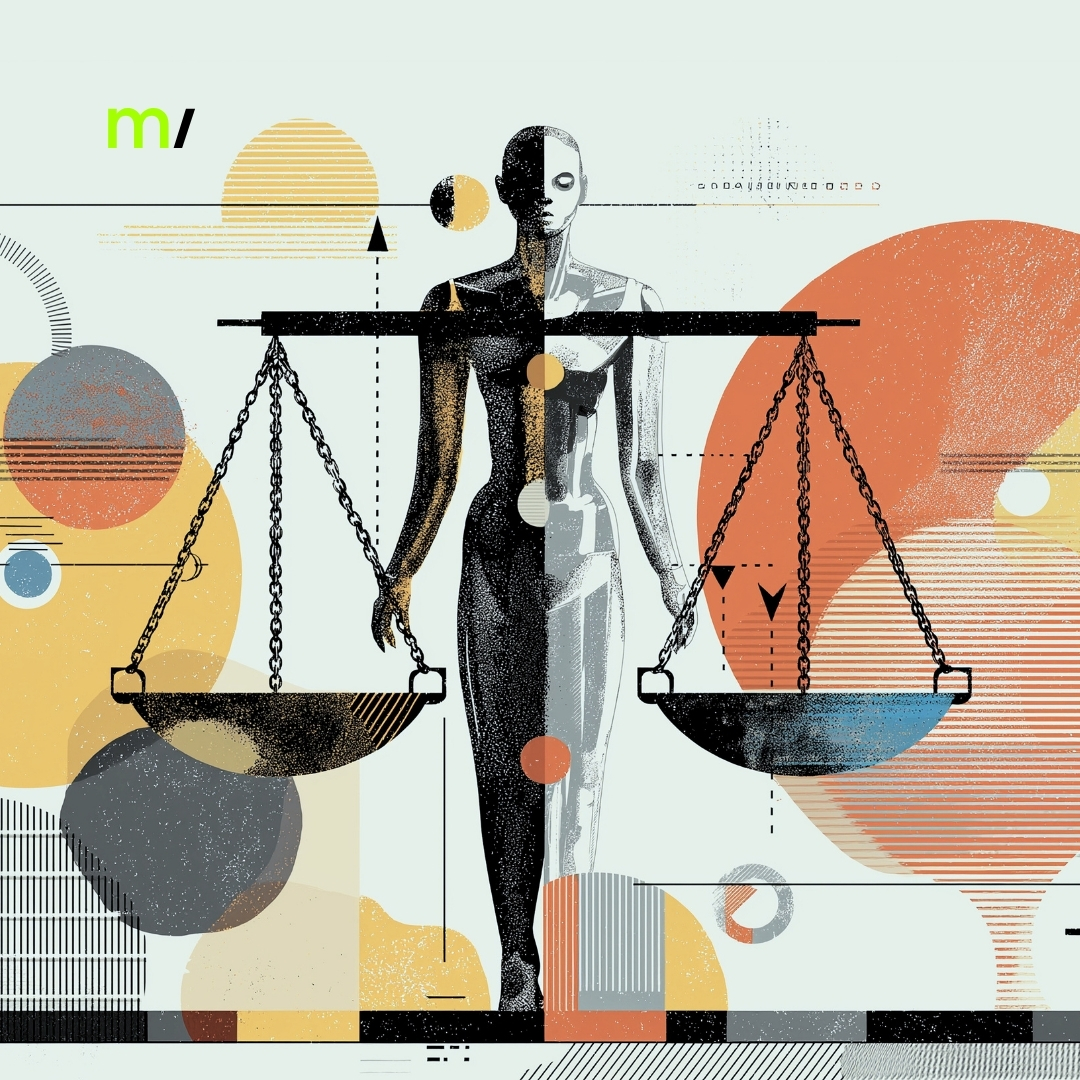

In the digital innovation ecosystem, regulation has often been viewed as an annoying background noise, a bureaucratic constraint capable only of slowing the race toward efficiency. Yet in 2026, the landscape has changed radically. The full entry into force of the European AI Act has not marked the end of experimentation, but the beginning of a new era: that of conscious Digital Transformation. For organizations like Macoev, which have always placed method at the center of the process, this is not a compliance challenge, but an extraordinary design opportunity.
Beyond Fear: Inhabiting the Perimeter of Rules
The most common mistake a company can make today is approaching Artificial Intelligence as a “black box” to be installed and forgotten. The European legislator, with rare foresight, has mandated a change of pace: AI must be anthropocentric. This means that technology can no longer be an isolated entity, it must reflect the values of the society that hosts it.
Designing today means knowing how to read the risk pyramid not as a prohibition, but as a map. If an AI system is classified as “high risk”, think of healthcare, human resources management, or critical infrastructure, the regulation is not asking us to stop. It is asking us to document, to be transparent, and to ensure that a human being always has the final say.
This is where the concept of “activating what is already there,” as we put it, finds its fullest expression: there is no need to replace human intelligence with blind automation; rather, it must be enhanced through a technical architecture that is, by definition, reliable and verifiable.
Auditability: The Algorithm Under the Lens
If AI’s debut was characterized by enthusiasm for performance, 2026 is the year of rigor. It is no longer enough for an artificial intelligence to “work”, one must be able to explain why it reached a particular decision. This introduces the pillar of Auditability (or verifiability).
In a digital transformation project, the integration of AI cannot bypass data traceability. Consider an assembly line in the textile sector or a sorting system in healthcare: if the algorithm suggests a change in workflow, the underlying architecture must be able to show the “logical path” it followed. For Macoev, this means designing systems that “speak.” Technical documentation is no longer a bureaucratic burden, but the logbook of innovation — ensuring that every automation is reversible and comprehensible to a human supervisor. The principle of Human-in-the-Loop thus becomes the beating heart of the code.
Legacy Data Remediation and “Ethical Cleansing”
An often-underestimated obstacle lies in the quality of the raw material: historical data. Many companies hold decades of information stored in legacy systems that inevitably reflect the biases or inefficiencies of the past. Implementing the AI Act means, first and foremost, carrying out a digital remediation exercise.
This is not merely a matter of reformatting databases, it involves verifying that such data does not feed discriminatory biases. If an algorithm is trained on partial historical data, the result will be automated injustice. The correct approach is one of subtraction: surgically selecting only what is needed to generate real value. In this sense, the digital consultant becomes a curator who ensures that a company’s technological legacy does not become a legal liability, but the launchpad for fair intelligence.
Transparency as a Competitive Asset
There is a fascinating paradox embedded in the new regulation: transparency is becoming the primary driver of trust between a brand and its end users. In a market saturated with invasive automations, the company that openly declares how and why it uses AI gains an immediate reputational advantage.
At Macoev, we believe that the User Experience (UX) of the future will be measured by the “honesty” of the information flow. Designing an interaction that complies with the AI Act means attending to every detail and ensuring that data is an ethical resource. Compliance thus becomes a form of engineering elegance: clean code is safe code; a clear process is a scalable process.
Toward a Digital “Quality Mark”
Ultimately, alignment with the AI Act is carving a deep divide in the market. On one side will be the “quick and disposable” solutions, built on generic and opaque models; on the other, there will be bespoke innovation. The latter is what Macoev champions: technology tailored to specific needs, where compliance is intrinsic to the code itself (Compliance by Design).
Soon, the market will demand a kind of “quality mark” for algorithms, similar to ISO certifications or environmental sustainability labels. Companies that have had the courage to invest today in clear governance will find themselves tomorrow in possession of an unassailable asset. We are not simply writing software; we are defining the social contract between businesses and their stakeholders for the next ten years. The future does not belong to those with the fastest algorithm, but to those with the most transparent one.
The AI Act is the best design tool the market has placed at our disposal. It forces us to step out of the logic of urgency and into the logic of importance. For companies that choose not to merely endure the regulation, but to inhabit it with creativity and rigor, the reward is longevity.
Innovating ethically is not only a moral duty, it is the only way to build digital infrastructures capable of standing the test of time. The future does not belong to those with the fastest algorithm, but to those with the most transparent, robust, and profoundly human one.
